Enough protein? Enough fiber? berryl shows you.
berryl shows protein and fiber right next to calories and adds the vitamins and minerals from food and supplements.
Tap what you eat today.
Every food counts straight into the bars. The magnesium supplement shows how berryl adds up food and capsule.
How much protein do you need per day?
Official reference values for healthy adults are close to each other in all our markets:
| Where | Protein per kg body weight per day | Source |
|---|---|---|
| United States | 0.8 g (RDA) | National Academies, NIH |
| United Kingdom | 0.75 g (RNI) | Department of Health / SACN |
| Australia and New Zealand | 0.75 g (women), 0.84 g (men) | NHMRC Nutrient Reference Values |
| European Union | 0.83 g (PRI) | EFSA |
At 75 kg (165 lb) that is roughly 60 g a day. These values are meant to cover the needs of nearly all healthy adults. They are not meant to define the best possible intake.
More can make sense if you are older or train a lot. Societies for geriatric and clinical nutrition recommend at least 1.0 to 1.2 g per kilogram from age 65. Sports nutrition organizations often cite about 1.2 to 2.0 g per kilogram for people who train regularly, depending on the goal. For muscle gain with strength training, intakes above about 1.6 g per kilogram did not add further gains on average in a large meta-analysis. There is no evidence that healthy adults who do not train benefit from much more.
If you have kidney disease, talk to your doctor before eating more protein. You set your own goal in berryl.
How much fiber is enough?
| Where | Fiber per day for adults | Source |
|---|---|---|
| United States | 14 g per 1,000 kcal, about 25 g (women) and 38 g (men) | National Academies (Adequate Intake) |
| United Kingdom | 30 g | SACN |
| Australia and New Zealand | 25 g (women), 30 g (men) | NHMRC Nutrient Reference Values |
| European Union | 25 g | EFSA |
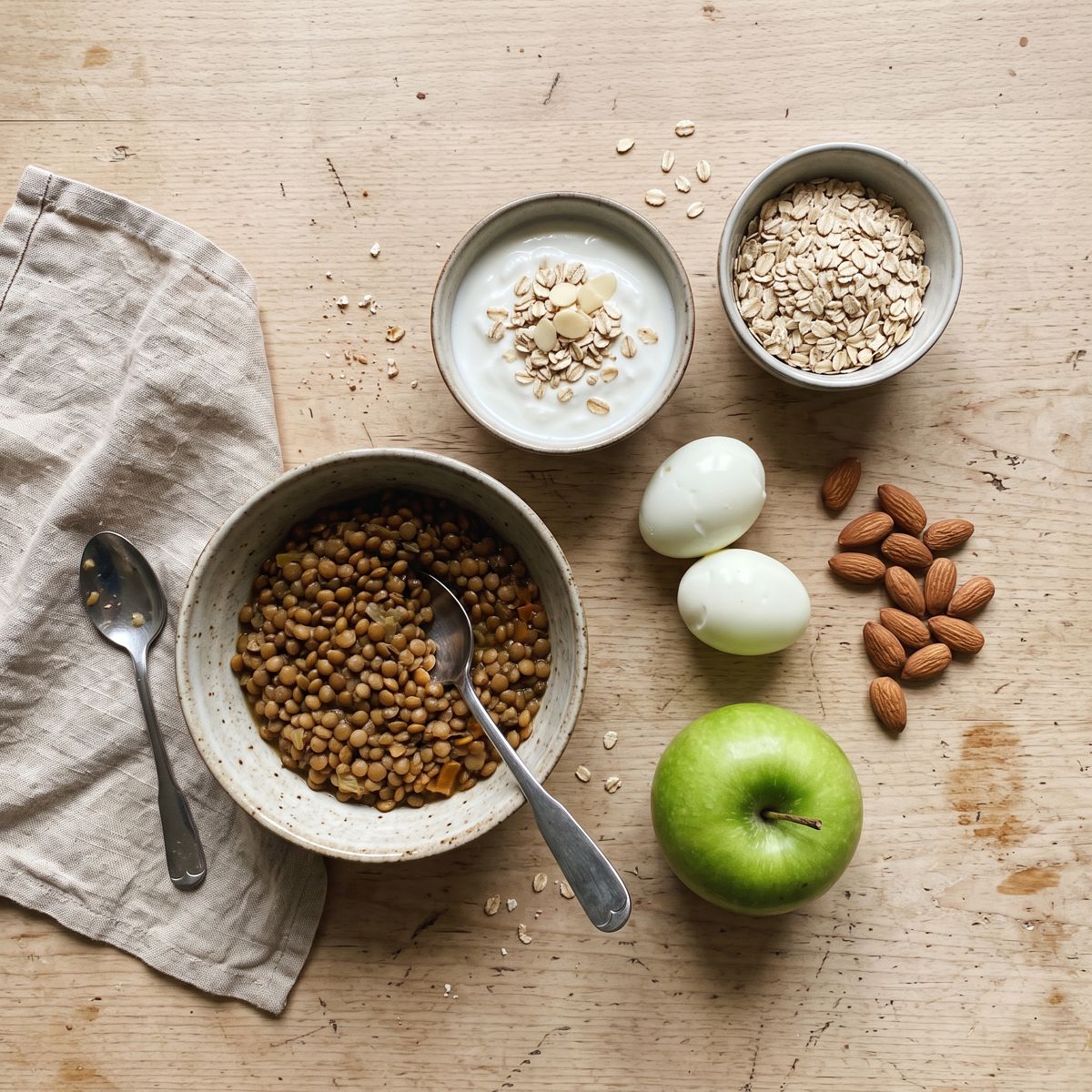
Surveys in all of these countries show that most adults eat less than that. Good sources are beans and lentils, whole grains, oats, vegetables, fruit and nuts.
| Food | Serving | Protein | Fiber |
|---|---|---|---|
| Lentils, cooked | 150 g (5.3 oz) | 14 g | 11 g |
| Rolled oats | 50 g (1.8 oz) | 7 g | 5 g |
| Almonds | 30 g (1 oz) | 7 g | 3 g |
| Apple | about 150 g | 1 g | 3 g |
| Skyr | 150 g (5.3 oz) | 16 g | 0 g |
| 2 eggs, boiled | about 110 g | 16 g | 0 g |
Values from the German Food Composition Database (BLS 4.0), rounded. BLS 4.0 partly measures fiber with a newer method that gives slightly higher values for some foods.
Why micronutrients belong in the picture
Vitamins and minerals come in the same food. If you also take supplements, you get them from two sources. berryl adds both up. You see how much magnesium comes from food and how much from the capsule, and where you are compared with the reference value and the upper limit. How berryl does the math is explained on How berryl calculates.
FAQ
Is there an app for protein and fiber?
Yes, berryl shows protein and fiber right next to calories and adds vitamins and minerals from food and supplements.
Can I set my own protein goal?
Yes. berryl suggests a value and you can change it at any time, for example to build muscle.
Does berryl count my supplements?
Yes. berryl adds the vitamins and minerals from the supplements in your routine to those from your food.
Work it out for free
The protein calculator shows how much protein you need a day, with the same levels as the app. All calculators
Ready for your day with berryl?
berryl launches on Android first, iPhone follows. Start free, no subscription needed.